Category: Uncategorized

  • What Even is a Movie? An Irrelevant Review of Dr. Horrible’s Singalong Blog

    What Even is a Movie? An Irrelevant Review of Dr. Horrible’s Singalong Blog

    Michael has been a fan of Dr. Horrible’s Singalong Blog for many, many years and I have to say that I’ve never been inspired to even be a little bit curious about it. Simply put, it doesn’t sound like something that I would enjoy. A little goofy, a little super villainous, and I had to be suspicious because I knew exactly one thing about it— that it starred Neil Patrick Harris. Consequently, in Michael’s eyes, it could be an absolutely miserable piece of artistic dreck, and he would still love it.

    So, given that it came out during the writer’s strike in 2008, I’m a little late to the party. But our whole family watched it last night and first of all, I should say right up front that it was fun and entertaining and what else do you want from sitting in front of the tv for an hour?

    But also, it gave me about a hundred different thoughts about what a movie is, or could be, and what it appears to be when you are an audience member.

    In the recent issue of The Atlantic, there was an article about Tom Hanks, which I really enjoyed. It was a bit of a puff piece, but I genuinely did enjoy getting to know a bit more about him, having grown up right around his heyday in Splash and Big and Sleepless in Seattle. He is just now publishing his first novel, which is about moviemaking. He explains why he wanted to write it this way: “I have found that absolutely everybody assumes they know how movies are made, and nobody does.”  And then: “Making a movies is exactly like starting a business, waging a war, getting to the moon, figuring out how to treat a disease, or coming up with public policing in order to make a city work better… Making a movie is as unknowable and as complex as any great saga or odyssey that is wrought with many turns of fate.” 

    I have to say that when I read this, I immediately believed him. I understood him to be saying that it’s just so complicated to put together a movie, to hire on a couple of thousand people and schedule things, and have unexpected things come up— it’s all some huge managerial and collaborative task that also has to stay true to some artistic vision through its problem solving. And because of that, every movie is its own thing. Each time someone goes to make a movie, it presents challenges that can’t be adequately anticipated beforehand, and it becomes its own sort of world.

    But as an audience member, this is really counterintuitive. Because if there’s another thing that movies almost always are, it’s formulaic. For instance, I just watched a movie on the plane called “About Fate,” and it was cute and light and fun, but not only did it adhere to a script, I mean, it really adhered to a script. By the end of the first scene/montage, I practically could have hit pause and then told you the entire rest of the story. 

    The story centers around two people who are both in sort-of bad relationships, and they meet by chance, dump their other people and wind up together. Which is a fine story, of course, and the gimmick in this case is how parallel their stories are, which is also fine. But the way the plot-points are portrayed is also incredibly circumscribed. One of the important subplots of the story is how the female heroine feels like a failure in her sister’s eyes and her sister is always screaming at her, and the two of them don’t get along. And right before the climax of the movie, there’s a scene in which the sister comes to her, lovingly, and just says shyly, “why do you hate me?” And the viewer is like, “What? That’s such an inversion!” It feels as much of a confrontation to the viewer as the sister, because that hasn’t been what their relationship has been like at all. And the writers use that moment to have the heroine realize that she can go after what she wants after all, and the story launches itself forward.

    As a viewer, we just accept it. This is what a movie calls for. Our heros were stumbling around, stuck in their own foibles, and then something happens and they are stirred to action, and then we can get on with wrapping up the story which we know must resolve. Those are the rules of movies, and we won’t feel whole without it. 

    So it’s easy to gloss over the fact that this particular event makes no sense. We haven’t been given any reason to believe that she hates her sister. In fact, we’ve had a well-developed sense of their conflict that doesn’t include this little reveal. We know that the sister is self-centered and unkind, and there’s nothing that leads us to believe that she would gently come and tell her sister to go for what she wants and encourage her.

    Nonetheless, we accept it really with no problem, because it’s the thing that lets the story do for us what we want it to do; descend into the world of our protagonists, understand their misery, and then get on out of it to a happy ending. And by these standards, About Fate is okay. It does the best it can with what it has, and it’s fun and pleasing.

    But then there’s Dr. Horrible’s Singalong Blog, which doesn’t do that, but instead does something radically different. I should say that it’s perhaps unfair to be talking about this in the scheme of movies, because it isn’t one. Technically, it’s three 14-minute episodes that only after-the-fact were put together on a DVD. But it still has a story, and the fact that it is different is every bit the point. It doesn’t adhere to the formula or the rules, and yet it comes out with joy and verve and success. Why?

    I’m going to go a little bit afield here, but I think an analogy will help me articulate a really satisfying answer. I (somewhat) recently read a book called Don’t Trust Your Gut: Using Data to Get What You Really Want in Life by Seth Stephens-Davidowitz. In one of the chapters, the author spends some time looking at who succeeds on dating websites. There are some lovely and surprising insights (if you can stomach economic ideas about what sort of racial-gender combinations come at a “discount” because of prejudice, I recommend the chapter because it’s fun and interesting.)

    In the book, he cites the work of mathematician and author Christian Rudder. Here’s what he writes.

    The mathematician and author Christian Rudder studied tens of millions of preferences on OkCupid to learn the qualities of the site’s most successful daters. He found— and this was not at all surprising— that the most prized daters are those blessed with conventional beauty; the Brad Pitts and Natalie Portmans of the world.

    But he found, in the mounds of data, other daters who did surprisingly well: those with extreme looks. Think, of example, of people with blue hair, body art, wild glasses, or shaved heads.

    Why? The key to these unconventional dates’ success is that, while many people aren’t especially attracted to them, or find them plainly unattractive, some people are really attracted to them. And in dating, that is what is most important. (Page 2).

    And so, here’s what I have to say that extrapolates this insight into the world of movie making. If you’re going to create a romantic comedy, the single best thing you can probably do is create When Harry Met Sally, or You’ve Got Mail or Jerry Maguire. Star power, a great premise, whip-smart writing, and characters that roll forward so beautifully so that even though you know what’s going to happen, you are riveted in watching how it all unrolls. That would be the dating website equivalent of your George Clooney, your Robert Redford, Audrey Hepburn, Ingrid Bergman, Scarlett Johansson, whomever else. Those beauties knock the rest of us out of the water the way that those movies blow past About Fate in the first scene.

    But if you’re not going to do that, maybe relax and be unapologetically, extremely weird. If you do that, there are plenty of people who are going to walk away after the first scene and say to themself, “Not my cup of tea.” But for the people who stay, it’s going to be an awesome romp of delight. 

    And that’s what Dr. Horrible’s Singalong Blog does, it makes its own rules. Right away, they freeze-frame the action in fantasy, letting you know that they’re doing their own version of realism and hero movies. In some places in the movie, the protagonist didn’t interact with the people right in front of him, almost the way that a stage actor can narrate right over the goings-on directly next to him, directly addressing the audience. They break out into song in the middle of sequences, and a weird chorus appears intermittently. This is a world in which wonderflonium exists right outside the typical laundromat. 

    In other places, the writers and actors leaned so heavily into cliches that it came right out the other side and felt fresh and beautiful. For instance, the protagonist refers to the other characters as “my nemesis” and “the girl of my dreams,” but this works. Evil Horse turns out to be an actual horse. 

    This is the dating website of purple hair and an usual number of piercings and what can I say? It’s some people’s cup of tea. A lot of people’s, actually— it has received a lot of critical acclaim. And I’d posit that it really isn’t that marginal. There is some fine storytelling, and I think that people are actually eager to suspend their disbelief, and enjoy the 42 minutes of a world where we root for a guy to defeat his nemesis and get the girl of his dreams. 

    And maybe Tom Hanks’ insight is not only the way to inspire a novel, but it’s own sort of advice to movie-makers. If each movie really is its own thing, a world unto itself, maybe it would be a more enjoyable world where the storytelling of the script weren’t the tightest thing about it. Maybe people want to suspend their disbelief a little bit more, enter worlds that are slightly weirder than just a weird premise or gimmick. If you let artists fly a little freer, (dye their hair, or tattoo their bodies, metaphorically speaking), maybe we’d come out with more movies that are little bit more like Dr. Horrible’s Singalong Blog and a little less like About Fate. And that would most assuredly be a good thing. 
  • The Atlantic, June 2023; A Review (along with a reflection on autonomy, liberalism, and mistakes)

    The Atlantic, June 2023; A Review (along with a reflection on autonomy, liberalism, and mistakes)

    Earlier this week, I found myself on a short plane ride without wifi— surely one of the last bastions  where a person has to content themself without new information for a couple of hours. And so I uncharacteristically had the opportunity to read an entire magazine issue from cover to cover. I picked a good one.

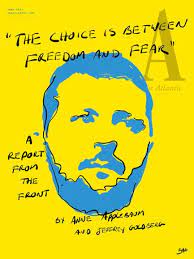
    The Atlantic June issue has a portrait of Volodymyr Zelensky in blue and yellow (rendered by Bono— yes, that Bono), and a quotation saying, “The choice is between freedom and fear.” While Jeffrey Goldberg, the editor of the magazine, writes in his note about the outstanding reporting in the magazine (and he himself reported on the Ukraine story that anchors the magazine this month), he doesn’t really reflect on the issue of this particular choice, but I saw it front-and-center throughout the stories. The quotation itself is sort of weirdly positioned (p. 23), and perhaps is meant to comment on the idea that Ukraine represents freedom as an “open, networked, flexible society” whereas Russia represents the past, where “commanders send waves of poorly armed conscripts to be slaughtered.” I might be misreading that though, because the quotation sounds like it wants to be about two choices for Ukraine to be making, whereas the article makes it seems as though freedom and fear are pitted like the two warring nations. 

    In any event, I suppose that these polarities of fear and freedom could anchor a conversation about nearly any contemporary issue, but nonetheless, in this case, I want to highlight something I noticed about the first and last articles in the issue. They are both warnings of a certain sort, and I think they make an interesting pair on exactly this tension. 

    The first article, the “Opening Argument,” is written by Ross Andersen. It is a conversation about Artificial Intelligence, and how and why we humans are tempted to give over some complicated decision making to artificial intelligence. It makes me think of how, in conversations and interviews about self-driving cars, human drivers tend to trust artificial intelligence more than is warranted by current technology. The explanation that I have always favored about this is that human beings know— from experience— just how fallible we are as drivers. We get tired, or angry— we squint in in winter afternoons to see our way through intersections. We get text messages or have to reach around to hand a juice box to a child. We reason that a machine that wasn’t subjected to these distractions of emotions or logistics would do better than we would.

    In other words, our human experiences lead us to believe that machines are more perfect, less susceptible to cloudy decision making. 

    Andersen points out that this is a mistake, because AI is really susceptible to other kinds of errors that humans don’t typically make. He writes, “In 2018, AI researchers demonstrated that tiny perturbations in images of animals could fool neural networks into misclassifying a panda as a gibbon.” We’re shocked that what we find so obviously simple is the very thing that trips up a computer, but this is exactly Andersen’s point. He writes, “If AIs encounter novel atmospheric phenomena that weren’t included in their training data, they may hallucinate incoming attacks.” Lest one think that four years is enough time to straighten that out and clear up any possible remaining atmospheric data around, he points out that human decision making in its slowness is perhaps its greatest asset. 

    AI is phenomenal at extrapolating from past examples. But by the time we get to the point of launching a nuclear missile, it will by very definition be a novel occurrence. There aren’t hundreds of nuclear wars we can train our AI models on. It will take human bravery and curiosity and hopefully diplomacy to pull us back from the brink and avert the disaster that will destroy humanity and leave the earth to the insects. AI is fallible, it can reason badly. In a novel situation, it almost always will, in ways that are surprising to humans.

    So it was really a funny coincidence that the last article in the magazine, written by David Brooks, so brilliantly echoed this worry from the opposite angle. 

    In “The Canadian Way of Death” by David Brooks (yes, that David Brooks), Brooks writes about how liberal values of autonomy led Canada to allow medically aided suicides called MAID, or medically assisted aid in dying. Anticipating the ways that this might be abused, regulations restricted this to people who, Brooks rights:

    “Had a serious illness or disability; the patient was in an “advanced state” of decline that could not be reversed; the patient was experiencing unbearable physical or mental suffering; the patient was at the point were natural death had become ‘reasonably foreseeable.’ (86). According to Brooks’ accounting, in just a few short years, many of these restrictions have been loosened, and several high profile cases have demonstrated that people have been approved through this system even though they were lonely or sad, that their suffering was primarily mental. He shows the logical end of autonomy by telling the case of a German man who murdered and ate his consenting victim, and asks what is the value of that consent? Can a single individual really decide to end their life by being eaten, or do we reject that as a society?

    While Brooks lays out his plan for adjusting our rights-based liberalism to a gifts-based liberalism, his plea betrays a different suspicion about human decision-making. If he is to be believed, then what he is really arguing is that humans, in all of their complexity, sometimes take in novel information and spit out the wrong answer. He cites the case of his friend, Washington Post columnist Michael Gerson, explaining that “when he was depressed, lying voices took up residence there, spewing out falsehoods he could scarcely see around.” Confronted with a new situation, but pattern matching to everything that happened before, Brooks concludes, “This is not an autonomous, rational mind,” Brooks writes.

    And in this worry, it is as though Andersen were worrying out loud about a depressed mind mistaking a panda and a gibbon. Brooks’ depressed person is running broken software and jumped to conclusions, in much the same way that Andersen’s AI has interpreted data and jumped into action without due deliberation. It is of great interest to me that the beginning and ending of the magazine focus on the idea of right information rendered wrong by either brains or computers. 

    The symmetry between these cases (just to spell it out further) is that both authors are worried about getting the bugs out of the system, of making sure that mistakes aren’t made with bad reasoning. At least Andersen seems to say clearly: although we want to tweak, improve, debug— it may not be as possible as we would believe. And Brooks’ solution is certainly to treat the depression, but also in some way to suspend a person’s full autonomy while we fix their brain from reasoning incorrectly. For Brooks, this dilemma of a poorly-reasoning brain is enough to take down the whole system— depression and its long tail of consequences enough to turn over the entire philosophy of Mills’ liberalism. According to Brooks, we ought not let broken systems (even rational human actors under the influence of depression) make permanent conclusions with big consequences. 

    But as I read these two arguments together, I’m wondering if this is really the right framing after all. We are taking mistake-making to be a feature of the decision maker, and spending time thinking through what is the right person/machine to be approaching a problem to best solve it.

    But perhaps mistake-making is not a feature of the decision-maker, but a baked-in part of a novel situation. Perhaps a situation that has not arisen before is, by its very nature, susceptible to incorrect conclusions, and destined to summon mistakes. Perfection is for the SATs only. The human experience may well be to bumble through life as new situations arise. If AI gets it wrong as much as we do, maybe it’s not that humans err, so much as erring is part of the way of the entire world. Mistakes are part of the architecture

    And with that, maybe, indeed, it all comes back to the quotation on the cover and the choice between freedom and fear. Fear would lead us to treat every decision as a possible bug, insist that there is a possible correct answer that the right system/decider could lead us to. And maybe preservation of human life is always the right answer. On the other hand, freedom could accept the possiblity of wrongness. The consequences of that may indeed be too high (get it wrong with nuclear war? Are you kidding!) so perhaps that isn’t a tolerable goal, but if we don’t accept that, we will be forced to confront the reality that we have, after all, chosen to live with fear. 

    Ariella Radwin is a writer and cultural commentator who lives in Palo Alto, California. She reads The Atlantic with great aplomb, although rarely in full.

  • Why I Hate Mothers’ Day

    Why I Hate Mothers’ Day

    I’m surely not alone in disliking Mothers’ Day. Over the past decade, I have noticed a growing recognition that this can sometimes be a hard day: for people with fraught relationships with mothers, whether alive or deceased, or women who had disappointing experiences with childbearing. There’s plenty of sadness and heartbreak around mothering, and this can be a day when those feelings are felt keenly, whether because of difficult circumstances or just the fact that even people with happy pictures can have sad and hard feelings. There are even greeting cards that mark some of these Mothers’ Day challenges, extending compassion to women with complicated relationships up and down the maternal line

    But that doesn’t describe me. My mother and mother-in-law are alive and well, and I have fond memories of my grandmothers. My own childbearing was not without its challenges, but I have four healthy and wonderful children who orient my life and whom I adore. 

    And yet, still, I hate Mother’s Day.

    When I pop onto social media, many of my married-to-women friends post pictures of their wives, often alongside their children, smiling of course. The captions praise these women for keeping the household running, for raising children, for being the glue that ties everyone together. The messages often cheaply point out that if it weren’t for these women, they’re not sure how they could keep track of the tedium of daily life. They talk about the unwavering support and care these mothers provide, offering a steady course through life’s stormy waters. And it is actually the simplicity of this praise for straightforward mothering which has me wishing I could push the fast-forward button on this day and arrive happily at a regular routine Monday.

    It bothers me to no end to think of “mothering” as a thing that people do, as though the pieces of that task are somehow enough of a coherent identity, separate from the rest of life, that merits its own consideration. To be clear, I don’t deny that there are a complicated set of tasks that surround women who mother. I spend most of my day doing them, and I do feel (as I suppose many women do), frequently under- or un-appreciated for bearing so many of the burdens that keep my family afloat, from children’s health and schooling to their emotional woes, not to mention the overwhelming lion’s share of household, upkeep, shopping, cooking, cleaning, and providing. 

    It’s not that I resent any particular effort to recognize me for the work I put in.

    But I do resent that the recognition for my work as a mother, when it descends upon me in this way, is so incredibly shallow and fungible. I am not valued for any particular way that I do any of these tasks. The recognition is essentially for my role as a stand-in.

    When I read on Facebook that ten of my married-to-women friends proclaim something like “Our kids are so lucky to have you, where would we be without you?” I want to point out that they haven’t identified anything particular at all about their wives, that they almost certainly would have said the same about any other wife they happened to have married. Where is the pleasure and recognition in that?

    Which is to say: I believe, almost out of necessity, that there is a unique way that I mother my children, for better or worse. To take a day to insist that the work that I do is so insanely similar to the work that every other woman does in their own mothering that we could have one day to celebrate the lot of us— that feels reductive to me in a way that is insulting.

    I remember my first Mothers’ Day as a parent— my eldest was just a few months old. At one of our well-baby visits, his pediatrician asked whether I had been able to connect with other first-time mothers with babies the same age. He offered that the HMO had mothers’ groups that began monthly, and he could easily connect me with a conglomeration of women who gave birth in October as I did. 

    The idea of packing up my baby to sit in a room and talk about spit-up with other women I didn’t know did not sound like my cup of tea. I fashioned myself as someone with so many interests that were particular to me, and a group that coalesced around this almost-accident of physiological processes, a group that took the complexity of my interests and personhood and tried to find me friends based upon my child’s birthdate? It did not appeal.

    “Six months ago, I wouldn’t have had anything at all in common with those women,” I said. “So I don’t suppose I would now either.”

    And that’s how I feel about Mothers’ Day as well. Do I have something in common with my mother and my mother-in-law, my grandmothers, all by virtue of having birthed and served and spending our lives in relationships with people who depended upon us for their very being? Well, sure, of course, I suppose I do.

    But I find it vastly more interesting to delight in the differences. (And “interesting” sometimes means exasperating— or worse). There are a million ways to mother. How lovely it would be to have a day that celebrated the weird way that I have chosen to do it, not the fungible role that makes every mother indistinguishable from one another, not the having-birthed, shopping-and-cleaning role that is the boring tedium of the world. Not even the “you always know what to say to make me feel better,” part, as though this were also part of the job description.

    No, save me from the hand-lettered platitudes that proclaim appreciation, the demands of “what would you like to do today?” and surround me instead with a day that celebrates that women are as diverse as the stars, that there is no common experience of mothering, that there are a million good ways to do it. Let’s drop the simple narrative that mothering is sacrifice, or emotional well-being, or instincts for safety, and instead embrace the simple truth that mothers are complicated humans the way the rest of us are. Honor the work they do? Sure, but let’s do it by honoring the complex people they are and not by reducing their stories to simple and vapid Hallmark sentiments of generic appreciation. 

    Ariella Radwin, a mother of four, has been a parent for nearly 18 years and has yet to find a Mothers’ Day celebration to enjoy. She does, however, believe that early May is a lovely time for floral bouquets, Sunday brunches, and hand-drawn pictures of cheerful daisies. 

  • The Uri Geller Museum

    On our recent trip to Israel, it took us more than a few days to shake off our jet lag and get through the first days of Passover. By the time we got out, it was to Jaffa, a place that all of us could remember fondly.  By some amazing miracle by Israeli-standards, we found street parking just a few blocks from the most interesting streets of town. As we got out of the car, I looked up and saw something that caught my eye: The Uri Geller museum? I had never heard of that.

    I had, however, heard of Uri Geller. Some sort of mentalist guy, bent spoons, debunked somewhere or another. A museum of spoon-bending sounded intriguing, so we wandered up and found a sign and two other travelers as curious as we were. There was a phone number and I prodded Michael to call. 

    Sure, they do private tours by arrangement. How was 1:15? Michael covered the receiver and shared the price. Should we do it? It wasn’t cheap, but it sounded weird and fun, and after a few tough days of jet lag, “weird and fun” sounded remarkably good. Had he been speaking to Uri Geller? Michael wasn’t sure, he hadn’t caught the name, but the sign on the door to the museum said that Uri himself conducts the tours, so we were pretty sure we would meet him later.

    It was better than “weird and fun.” It ended up being the highlight of our trip to Israel.

    After a couple of hours that included darting in and out of Jaffa’s little overcrowded antique shops, we navigated our way to the museum, finding ourselves in a building of pale limestone. It was cavernous on the inside and brightly lit, but it also felt cool compared to the street, almost the way that a cave stays at the average annual temperature of its place on the planet, always insulated from the weather outside. Almost the entirety of the museum was one very large room with a couple of beams in the middle, stuffed to the brim with framed photos and posters and other materials. In one corner was a car, covered in bent spoons. There were things to look at and read in every direction, and yet our attention was almost always riveted in exactly one place— on Uri Geller, who stood in front of us in his lanky frame, holding a little amplifier and speaking into a microphone to protect his voice from projecting in the big space.

    Uri Geller is first and foremost an entertainer. He has been performing and entertaining people since 1968, and a lot happens in a lifetime of transporting people into worlds of the amusing or improbable. 

    The museum is a collection of, well… of his adventures. It contains memorabilia from the way he conducted his life and the people whom he got to meet. Right above the reception desk, for instance, is a hanging cord with hundreds and hundreds of keys, which turned out to be room keys from all of the hotels he stayed in over the years. Why he saved them (and what he did with all the modern key-cards of the past decade), I can’t know, but he did explain that he so kindly asked the manager of the hotel each time if he might please keep the key. It makes a stunning visual display of just how many places he has been, and a delightful introduction to a museum of those travels and connections.

    One of the first stops on our tour was a picture of Uri with John Lennon, next to which was framed a weird gold oblong object. On its own, it might not have been very interesting, but as it was, Uri was standing there, with his microphone, telling us about John Lennon. Telling us about that day in New York in the Dakotas, the day that Mark David Chapman asked for Lennon’s autograph and chatted amiably with him, then returned later that night as an assassin. And the gold object might not have been that compelling if not for the fact that John Lennon apparently called Geller to explain that an alien— a real alien— had come and woken him out of his sleep and handed him this golden egg, which Uri Geller now has framed next to the photo of the two of them, and a newspaper story about Lennon’s death. It wouldn’t have been quite as meaningful if Uri didn’t head off the exact questions anyone would ask by explaining that John Lennon was definitely sober at the time, and that he (Uri) didn’t want to have the object tested because he’d rather believe than find out it was mass produced in China.

    And that maybe was the entire essence of the museum for me. Skeptical-me knows that of course Lennon wasn’t sober at the time that an “alien” visited him, and definitely that object comes from earth. But happy-me, in Uri-Geller land, found it so fun to just romp through history, vicariously hob-nob with politicians and pop stars and artists and all of the other cool people who came into his life, gave him gifts or stories, and see how Uri passes them on.

    For nearly two spell-binding hours, we heard how Uri passed up the chance to buy a couple of Andy Warhol paintings (and his probably net worth if he hadn’t), how he was investigated by the CIA and found to have special powers, and how he came to renovate a former soap-factory in Jaffa to use as his museum. Corners of the museum are devoted to his connections to Michael Jackson, Salvador Dali, and Elton John. His stories varied from funny to unbelievable to tragic, as he even narrated and explained the model airplane he has hanging from the ceiling, a passive-aggressive gift by Muammar Gadhafi to remind Uri Geller of the Israeli attack on Libyan flight 114. Geller told us the whole story, sharing the responsibility of the civilian catastrophe alongside the Israeli fears that led to the tragedy. And then he went ahead to explain about Gadhafi pitching a tent in Donald Trump’s property in Bedford, New York.

    All of this part is actually true, or at least wikipedia backs him up on this, and I suppose that most of what he told us was verifiable in some way, including the report card he has from his first grade teacher which claims that he has “strange abilities.” Still, it’s a bending of the mind to sort out reality from entertainment, and so— we just didn’t. Instead, we just looked at pictures of Uri Geller with his arms around Mick Jagger, and saw the jerseys for the soccer team he owns in his own private country, and promised that we would becomes citizens of  Lamb Island for $1 by going to his website. We saw his art, and met his brother-in-law, and enjoyed being entertained.

    And you know what my takeaway from all of this was? That it’s fun to lead a life where your passions and talents take you. We got to witness a person having fun doing that his entire life, and doing it still. It’s worth noting that before Uri Geller, there was no special job title that was called “spoon bending mentalist.” He says he bent his first spoon by accident when he was five. A funny parlor trick, useless in the world of careers. Except that it has led to a life rich in experiences, humor, and satisfaction. He makes art, he invests in an archaeological project, he dotes on his grandkids, and he entertains visitors from around the world, donating the proceeds to charity.

    The upshot for my kids? It was their favorite part of the entire trip to Israel. At the end, he bent a spoon for us and signed it. He then handed it to Emma, who insists that because of that, it is hers, and she’s not letting it go.

    “It’s funny,” my friend David said, “when the most memorable part of a trip is something that has nothing to do with the place that you were.” It’s true that all of this memorabilia is portable, so we could have been anywhere and gone to this museum, but there we were. Uri Geller is now an inalienable part of our Old Jaffa landscape. In a building that used to make soap— one that turned olive oil into balm for the skin, we saw our own little magic, a balm for the imagination and soul. If you’re ever in Jaffa, I suggest you give him a call. 

    Ariella Radwin is a mother and writer who has lived both in Israel and the United States. She has rarely succeeded at planning family trips more than a couple of hours in advance, and greatly enjoys how Israeli culture remains open to last-minute adventures. She now proudly hangs in her own home a picture of the famed Uri Geller alongside her own family, as well as a spoon bent and handed to her daughter.

  • Rattled by Road Rage (and Privilege)

    I’m still shaking a little, and if I can steady my hands a bit, I’d like to tell you about it. You see, this morning, I was biking Emma to school, which I don’t usually do. But since we moved, there’s an extra intersection to cross which I worry about a teeny bit.

    Today, we got a couple of feet into the intersection in the crosswalk, and a car was speeding along down the road, so I yelled at Emma not to go. She hit her brakes, hard, and then I yelled at the car to “watch it.” Or something like that. I actually yell at cars at that intersection probably fairly often— the road looks like it should go fast, and it’s not that uncommon to for cars to race by without even noticing that there is a crosswalk, let alone a pedestrian standing there. My hope in yelling is that I can maybe jolt them out of their automaticity in driving in our neighborhood, and that next time they drive there, they will pay a little more attention. 

    This time, though, the driver heard my yell and came to a screeching and dramatic halt in the middle of the two-lane street. She exited her vehicle and began screaming at me, “IT’S NOT MY JOB to see if you want to cross the street or not. TEACH YOUR DAUGHTER THE RIGHT WAY.” She was standing by the side of her car, and I was on my bike, having crossed the street by now. I was frankly surprised that she could think that she was in the right, but she continued yelling without stopping, insisting that because we paused to let her speed by, she had the right of way. And you know what? I started yelling back.

    “CROSSWALK! CROSSWALK!”

    She continued screaming about teaching my daughter “the right way” and I all of a sudden, I was saying, “right of way, right of way, right of way” and pointing at myself which is all I could think to say. Now that I reflect on it, it was almost like twisting her words back at her, because who can think straight when they’re being yelled at? I noticed that a neighbor was watching the whole thing, me on my bike on the far side of the street, she standing by the side of her car parked in the middle of the street, gesturing and screaming at me.

    “Go on to school, Emma,” I said, deciding to loop back towards her car, where I slowly read her license plate out loud before circling back and catching up with Emma and leaving the scene behind.

    “I’m sorry, Emma,” I said, trying to calm us both, as she was as rattled as I was. “You see? You manage to get to school on your own every single day and the one day I come, I make trouble.”

    And teary-eyed, she said back to me, “No, I would have died today if you hadn’t been there. I don’t want to die.”

    Writing this, my watch has just indicated to me that my stress is a “little high” and don’t I want to take a couple of relaxing breaths?

    The thing is, I am worked up about this. I’m not iron-clad sure I didn’t act really badly too. Maybe Emma could have crossed safely before the car came by, or maybe I should stop yelling at cars even if they’re not driving well. But I am absolutely positive that she should have stopped for us to cross, so I called the police afterwards. I gave the license plate, I told him there was another witness, but he said that there wasn’t much they could do after the fact. 

    What did I want them to do anyways? 

    Because here’s one other thing. I am a white woman who lives in Palo Alto. I was confident that I would be believed by the officer. I was certain that they would understand that I as a cyclist was treated badly by a driver who had not ceded the right of way. But I don’t know what would happen if they knocked on her door and found a large black woman who seems like she might have been intimidating to a bicyclist. Calling the police was a form of privilege. Restraining myself from using my privilege does NOT trump pedestrian and cyclist safety, but it’s not nothing either.

    And then I thought of another recent incident which was even more upsetting, and maybe this is the real reason my watch keeps bugging me to take a breath. 

    On our flight to Israel in April, a guy seated across the aisle from us was trying to get his roller bag overhead and it didn’t quite fit. It almost did, but then the compartment wouldn’t latch on one side. I could see that if he just turned the bag sideways, it would close, so I suggested that to him as he tried to push it closed again, again, again.

    “No, it’s good enough,” he said.

    “Well, they won’t take off without it latched,” I said, “so you should just fix it now.”

    He pushed it again.

    “No, the latch is just broken on this one, it won’t close any further.”

    The overhead compartment was directly opposite our seats. Based on the partial way it was latching, it wasn’t certain that it would open on its own in the middle of the flight. But if it did, his tightly jammed and heavy luggage was going to fall on our heads.

    So when the stewardess came by a few minutes later, I gestured to it above my head and told her that although the compartment looked closed, it wasn’t latching.

    She examined it. “Good catch,” she said to me, “we would have found it sooner or later, but now is better.”

    The man glared at me briefly, and then he began to mansplain to the flight attendant that the latch was broken, and that his closing was as good as it was going to get.

    As is her job, she insisted that he move his bag to an appropriate location and demonstrated that the compartment was fully operational when his luggage wasn’t in it. By now, more people had come onto the plane and put their luggage up, so there were fewer spots available for his bag. She patiently located a spot for him, but it was two rows behind his seat. He seethed at her that it was too far away, that he could not be that far away from his carryon luggage for the duration of the flight. She told him that he needed to calm down or he was going to be asked to get off the plane. He didn’t understand the threat, and continued to insist on the proximity of his bag to his person.

    She had a million other things to do. I tried to tune it out. Eventually it resolved. Or seemed to.

    And then, once she was gone, he turned his attention to me. “People should mind their own business,” he rasped at me. Did he say more to me than that?

    “They weren’t going to take off like that and if it fell, it was going to fall on my family” I said back. We had been boarding for an hour, anticipating a long flight. “I was actually trying to help you.”

    “Help me!” He scoffed and made a face. Somehow it escalated. He started to yell at me. I yelled back. I was in the right; I knew the rules, the flight attendant had backed me up. Planes don’t take off when luggage threatens to fall on people’s heads.

    Still, my heart raced and I think I couldn’t see straight. I abruptly stopped looking at him and instead looked around frantically for the flight attendant. 

    “Excuse me!”  I yelled across the aisle to her. All of a sudden, I knew for certain that I couldn’t have him near my family for fifteen hours. 

    I caught her eye. “Excuse me! He is now blaming me for his luggage, and I don’t feel safe!”

    This was all true. I think I blanked out a little. She came back. More threats about deplaning. I think he finally understood his flight was at risk. Michael tried to tell me, “he’s just being Israeli.” He was trying to lower the stakes and help me shrug it off. 

    I had been yelling too. I’m not positive that, if you could watch a video right in the middle, that it would be clear that he was an aggressor and I was a victim. He definitely felt like a victim, even though it was hard for me to see him that way. Meanwhile, I didn’t have any doubt— if I got a flight attendant involved, I was going to be believed against a big burly Israeli man who had different norms of appropriate and aggressive behavior. 

    The flight attendant asked him to apologize to me. He never did that, but he did calm down and I never talked to him the rest of the flight. But I did notice; he didn’t touch his bag in the overhead a single time in the entire fourteen hours. I don’t know why I mention that as though it was some sort of vindication for me.

    The whole thing was unfortunate. I have tried describing what this was like, as well as his insistence on his luggage being nearby, his certainty that it “would have been fine” if I never said anything about his luggage. I’ve tried on the idea that I was being excessively cautious, that I interfered and should have just let the flight attendants solve it (I honestly was trying to help him out because I knew that by the time they discovered it on their own, it would have been much too late to get his luggage anywhere near him). And maybe really he was right: people should mind their own business.

    It always seemed to me that Israelis are surprisingly lackadaisical about safety. One time, just walking through the city, we came upon a city employee trimming trees with a chainsaw. He placed it down on the sidewalk just as we were walking by, the instrument still chugging along. I steered the kids around it, as it inched itself forward on its own motor power. 

    I don’t like the image of myself as an overly worrying mama bear who sounds the alarm about safety protocol when it’s easy to just walk around it. I don’t like the image of myself as someone who picks fights unnecessarily. And I don’t like the idea that I use authority figures to help reinforce my own privilege.

    But I’ll never take lightly someone else’s well-being or safety, and I will never give up on living in a world where other do the same for me.

    And with that hope, and having written this all down, just now, I finally gave in to my watch. A few minutes of well-chosen slow breathing exercises. I feel almost as good as new. I’ll know that I really am all better when I forget her license plate number. 

    And tomorrow, I’m going back to the old habits which were working better— Emma can bike to school herself. Whether or not that lady cedes the right of way, I’m pretty sure that Emma won’t forget to stop at that intersection, and maybe that’s the real reason to yell at erring drivers. Not to convince the drivers to change their driving, but to remind me and my kids not to neglect our own vigilance on the road. But maybe vigilance about overhead compartments should best be left to professionals.

    And as one last concluding thought, I want to offer so much gratitude to all of the people who work hard for my own private and for public safety— police officers, traffic safety officers, crossing guards, flight attendants, and the tree trimmers in the United States who cordon off their work areas.

    Stay safe, everyone! And breathe.

  • The Distraction of Uncertainty

    When I was first pregnant, I drew great comfort from the internet, which supplied an endless virtual cohort. Even though I couldn’t bring myself to utter out loud any details of my delicate state, I drew comfort from stories and experiences on message boards and knew weird details of the lives of women who were willing to reveal them.

    One of my favorite subgenres of pregnancy stories involved the fog of pregnancy, the seeming inability to think clearly. I really enjoyed the implication that this was no personal fault, but rather due to hormones and processes that were not only beyond my own control, but for a noble and laudable cause of nurturing a new life. There were stories of forgotten keys, hilarious mixed-up sentences, and scrambled directions. But my favorite anecdote was described by a woman who woke up exhausted and in desperate need of caffeine, drove and rushed to the drive in coffee. She ordered her coffee from the security of her car and paid for it, and then, thinking her task complete, she drove right past the pickup window and onto the street before realizing her mistake. I think that one tickled me in particular because even single minded desperation and focus wasn’t enough to get her what she wanted. 

    Although it has been many years since I was pregnant, I did my own version of that the other day. On Mondays, one of my kids has a tight pickup from one orchestra to the next, which involves complicated biking (on their part) and ferrying instruments (on my part) and then bikes and a short time window. And I am pretty desperate not to be late because all of this is important to them, and an orchestra thrives on precision, and these are all noble lessons that they are learning so beautifully. But on that particular day, I was practically spinning in circles with a to-do list that was like Kerberos’ head— every time I slayed one foe, three more would grow in its place. 

    But I was determined, with timers and constant vigilance not to be late for that pickup. And to my credit— I wasn’t. But as I drove up close to the site of the pickup from orchestra rehearsal #1, I quite suddenly realized that although I was going to be on time to pick up my kid, I did NOT HAVE THE INSTRUMENT IN THE CAR. It was still sitting at home, in the entryway, where they had left it that morning so I could bring it for them, according to the agreement we had made together. I could get the kid to orchestra, but um… that wasn’t going to cut it.

    In the end, Michael bailed me out by choosing a pickup place enroute and driving the instrument to meet us and it all worked out, but it was still stunning to me: where was my brain, exactly?

    Except that I knew where it was, because it wasn’t whole, it too was busy subdividing into little fragments that scattered in every direction, along with each task on my to-do list, but with combinations of uncertainty layered on top. In my case, uncertainty was around a possible move (which ended up happening— more on that another time!)

    But all of this makes me think that maybe uncertainty is the greatest enemy of focus. Perhaps it is precisely the fact that something might or might not work out that is so incredibly distracting that it’s hard to pay attention and proceed with life as usual, including buying coffee at a drive-thru. I mean, isn’t that part of what is going on in pregnancy? There’s this change brewing, but actually, even with a due date on the calendar and plenty of time to prepare, the essence of nurturing a pregnancy is not knowing and not being able to anticipate the new person who is going to disrupt the status quo. 

    Michael was recently describing to me at work a major initiative in his new team that was exciting and mobilizing, and then there was a meeting with the legal team which explained that no part of it should be implemented based on a conservative interpretation of some regulations. This was a shock and a big deal and the first time ever that Michael wanted a drink in the middle of a workday. And maybe the legal team is just being cautious and maybe part of his team’s plan could be implemented, or maybe they’ll find a way to do all of it, but meanwhile, he has to decide whether to continue to do the technical work. But it’s hard because every time he moves one step forward, he is distracted by the thought that perhaps it will prove to be futile. It’s hard to even sit down and make a timeline for his project in a hypothetical way, because the chance that it might not work out is like a deep well of quicksand he has to wade through as he slogs through work that would be difficult in any event. 

    As we all learned through a global pandemic, change is stressful. Even “positive” changes (like new marriages and health restored or immunity) get coded by the body as physiologically challenging. And this is worth paying attention to, and giving ourselves grace and self-compassion.

    But I think that uncertainty is a different kind of change that needs its own category. Persevering through known challenges is a different sort of thing than the haunting suspicion that it might not all work out. Having a diagnosis is difficult, sometimes heartbreakingly and catastrophically so. But awaiting a diagnosis, waiting to meet with the doctor for a discussion of protocol, waiting to hear about test results— these are its own kind of suffering, but one that doesn’t get coded as such. At least, I don’t know how to respond to it.

    If I hear about a friend who has received a difficult diagnosis, I might say that “I am sorry to hear your health news.” But if I said that to a friend who was waiting to hear about a diagnosis, it would sound as though I had already presumed bad news! And I wouldn’t want to be mistaken to have said that. What I would want to mean— so desperately want to mean— is that I know it’s hard to remember about the coffee, the orchestra instrument, the work at hand when there’s the chance that pretty soon the whole cart is going to be tipped over and you’ll be leading a different kind of life with different priorities for a while. 

    In my doctoral dissertation, I wrote about uncertainty, and how it was treated differently in different historical time periods. Sometimes, it is all but intolerable. And an elaborate structure around it can make it feel more definite and concrete, but I’m still up for some sort of cultural way to recognize: the family who has been evicted but hasn’t found a new home yet, the person whose company has announced that there will be layoffs but not yet announced who is affected, the volunteer who has qualified as a foster parent but hasn’t yet had a child placed with them.

    Maybe in my lifetime we’ll find some way to honor the blur of those situations in addition to our instinct to applaud those who push through in particularly impressive ways.

  • Anti-Semitism on Campus?

    We’re just beginning the college exploration process with our high-schooler. There are a staggering number of things to think about to help him figure out what might be a good fit for him, on a campus that will allow him to pursue his interests and develop into a full-fledged independent young adult. As we think about undergraduate size and history and geography and academic programs (all of which seem like quite worthy considerations), people keep mentioning something else that makes me feel a little more uneasy.

    “Antisemitism on campus” somehow keeps coming up as a criterion for consideration. As in: some people have flagged campuses where (for the most part) anti-Israel sentiment runs high, and encourage students with engaged Jewish identities to steer clear of these toxic and misguided learning environments.

    I want my kid to feel comfortable on campus, so it’s not like I shouldn’t pay attention to this sort of thing. But the most recent campus to get mentioned to me as “avoid” is a large public university with a huge and vibrant Hillel, in a city with an enormous Jewish population and extraordinary resources for Jewish identity and learning. Really?

    I have two gut reactions. One is: how singular is our criteria for establishing a good place for Jews both in a secular capacity to learn and study in a university, and in a religious capacity to grow and develop in Jewish identity and learning. Are we going to collapse all of that complexity into sentiments around Israel? And specifically, if we insist that a campus sentiment that disapproves of the Israeli government makes it unsafe for Jewish identity, what exactly are we telling young Jews who also disapprove of the Israeli government? That they themselves are also a threat to Jewish identity? This seems an odd move at a time when Israeli scholars and academics themselves are asking for Jewish Americans to protest the current actions of their government. I think that if we are going to rank campuses on their Jewish-goodness, we should consider an awful lot more than whether or not small anti-Israel activist groups exist there. 

    Secondly, I wonder what the end-game is here. Is the idea of keeping Jews off of anti-Semitic campuses that we should cede those spaces to anti-Israel sentiment? Are we really telling our young adults that when they see something that offends their moral sensibilities, their best bet is to let the bullies have their arena and we should find some safe spaces? I’m not suggesting that every Jew needs to go in to a harsh campus to protest and makes waves and commit to changing campus culture (goodness knows, I would have hated that), but isn’t this sort of just an extension of cancel culture and trigger warnings, writ-large? As in: you might, on campus, hear or see something that you don’t like, so in order to avoid that, stick with a campus where you will be comfortably ensconced with other people who share your opinions (and background, and religion).

    I brought this up with Michael this morning, and his point was that, if we were talking about the sort of anti-Semitism that leads to pogroms, then of course, those would be worthy places to avoid. If there were colleges that refused to let Jews engage in certain academic programs, or who restricted the number of good grades Jews could earn, or who charged more tuition for Jewish students— by all means, let’s keep our young students away.

    But a campus with outstanding learning opportunities, that also happens to have a core of students devoted to Palestinian freedom? Let’s please not code that as a place to avoid. Let’s not decide that Jews shouldn’t step onto campus lest they be inspired to wave an Israeli flag opposite a Palestinian one. Or better yet— to establish a campus Israeli-Palestinian dialogue like the one at the private university I attended. 

    There is a lot to be said about the way that anti-Israel sentiment drives anti-Semitism, and the (not quite enough) space that there is to protest the actions of an independent nation without casting shade on an entire religious group without formal ties to that government. In an ideal world, all institutions of higher learning would be safe places for students of all religions to thrive. It seems doubtful that blacklisting some campuses for highly-publicized anti-Semitic incidents is going to help bring about that dream. 

  • Remembering the Holocaust and Honoring Jews

    Today is Yom HaShoah, Holocaust Remembrance Day. In Israel, it was celebrated (as it is every year) with a siren at 10:00 am that sounds throughout the country, causing life to come to a complete halt for a solid minute. Cars stop on the highway, doctors stop in surgery, children stop in recess, and the whole country comes to its feet and stands in silence. There are other ceremonies, remembrances, and conversations that happen on this day, but even if you ignore all of them, at the bare minimum, you can’t lose track of the day because that one minute sure lasts a long time.

    Here in the United States, there is no siren, although communities often organize their own memorials. This week, several of my friends have been recommending an article in The Atlantic by Dara Horn, published this week, surely with a non-coincidental publication date. It’s called: Is Holocaust Education Making Anti-Semitism Worse? Using dead Jews as symbols isn’t helping living ones. I read Dara Horn’s book People Love Dead Jews last year, and found it thought-provoking and interesting, even though I definitely didn’t agree with everything she said.

    In my own family, and circulating in discussions of friends, and on billboards, there has been an increasing amount of chatter about a recent or trending rise in anti-Semitism. To be clear, I haven’t personally felt it. But enough people close to me have that it feels like something to be alert about, and a claim that holocaust education could be exacerbating anti-Semitism is certainly interesting, as her article’s title claims.

    Before I even read it, I mapped it onto somethign that Dara Horn had said in a couple of the interviews she gave about her book. She complained that when she spoke to Jewish audiences, they could easily rattle off the names of many of the Nazi death camps. Auschwitz. Treblinka. Bergen-Belsen. They roll off the tongue with solemnity. But could these same audiences name Yiddish authors? The famous ones who had perished in those camps? Whose lives and livelihoods and culture were stamped out by Nazi sadism and genocidal efficiency?

    I liked her question. Sometimes I have had the same reaction. There’s a gruesome salaciousness to entering the details of death and murder, and why do we have to talk about it so much and foreground it so much, when we could instead be honoring the victims not in their deaths but in the accomplishments of their lives.

    And then I think about my family’s recent visit to the Museum of Tolerance in Los Angeles. So so so many painful stories, but the one that I can’t get out of my head is a woman who narrates how her nephew was being born just as the Nazis invaded the town. The Nazis were rounding up all the Jews— or starting to— so despite the chaos, she hightailed it to the hospital where her sister was recovering from childbirth, hoping to reunite before whatever fate was in store for them. Unsurprisingly, she couldn’t get in to the building because it was blockaded. Standing on the steps near the entrance, she saw bundles start to rain down from one of the upper floors, tossed to the ground like garbage. She — and the other bystanders down below— couldn’t quite make sense of what was happening. Some of the bundles had human-like form. Were they dolls? Why were Nazis tossing dolls out the window of the hospital?

    And then the wailing. Those, of course, were newborn babies, thrown to their deaths hours after being born. 

    It was hard to take in. It was impossible to believe. Unfathomable to explain.

    She never met her nephew. She never saw her sister again. 

    So you want to know why we talk about the Holocaust? Because that. That is why. How can that happen in a person’s lifetime and then not talk about it? How can I occupy the same world where that happened and not go on and on about it, like a memorial?

    I went to read the actual essay with a mixture of strong thoughts and feelings. Here’s the upshot: it’s a powerful and gorgeous essay, and she asks wonderful questions. Among other things, she points out that using these stories to create feel-good convictions of moral superiority that begin and end with, “I would never throw a baby out of a window” perhaps misses the chance to more deeply examine human motivations, political power and sadistic impulses. 

    And she wonders whether Holocaust education in its safe historical distance might actually be a chance to shy away from more relevant, devastating and difficult issues. Horn makes a case both for contextualizing the long history of anti-Semitism, and for deeper engagement with contemporary Jewish practice. And perhaps the two could come together, even though it’s hard for me to imagine a great educational world where non-Jewish teachers routinely lecture students about Jewish beliefs, culture, and practice. 

    Which brings me to my personal worry about Holocaust education. Whether universalizing, particularizing, simulation-based, antiseptic in its historicity— how does a classroom engage with this content at all? What about a student…like me? Which is to say, someone who gets horribly, horrifically, catastrophically sad— all while sitting inside a classroom which typically has infrastructure, grades, and desired educational outcomes and not a lot of capacity for outright weeping. Sadness is not an educational goal. It doesn’t align with grade-based standards. It might not even be possible or advisable.

    There are many Holocaust scholars and educators in this country. They know all about the history and the mechanisms and the torture and the systematic genocide. And they talk to students every day. Maybe they have a level of dispassion about the details, or maybe they feel crushed every day.

    But I know that for myself, I can’t go to a Holocaust museum to learn the descent from anti-Semitism to madness and not grow despondent. I can’t wander through the stories and the halls and then leave to go eat lunch. My response isn’t activism. It isn’t conviction. It isn’t a moral lesson about the threat of tyranny, despair over the human penchant for cruelty, or the uplifted feeling of knowing there were those who risked their lives to do good. It is just plain sadness. 

    Deep, deep wells of sadness. Wordlessly sad. Sad like a siren which shrieks for a minute with no words. No words are up to the task.

    And with that said, for a situation that words can’t capture, on this Holocaust day, Dara Horn manages an awful lot of very powerful ones. I’m happy to have this anchor my own private remembrances this day, and highly suggest you go and read it too.

  • Love, Service, and Choosing a Career

    It was in the course of reading Micah Goodman’s essay in the periodical Sources that I first came across the formulation of love by Erich Fromm.

    In the essay, Goodman explains Fromm’s work this way:

    In 1956, the psychologist Erich Fromm published his groundbreaking book The Art of Loving, a fascinating indictment of much of  Western society. Fromm argued that the primary impulse of modern human beings is to be loved. That is why they go on diets, run marathons, and develop impressive careers. All for love. Fromm urged Western society to undergo an emotional revolution. Instead of seeking to be more loved, people should seek to be more loving. Loving, according to Fromm, is an acquired skill. It is an emotional muscle developed with much strain and hard work.

    That sounded like something I needed to learn more about! At first blush, it sounded as though this were a version of John F. Kennedy’s famous formulation in his first inaugural address:

    “And so, my fellow Americans: ask not what your country can do for you – ask what you can do for your country.” 

    I’ve always particularly loved Kennedy’s formulation. I wasn’t alive when he said it, but it is just the sort of turn-it-upside-down formulation that stops me in my tracks, even when I read those words today. Without any accusation, it makes me think of my own selfishness, and feel inspired to serve, perhaps even sacrifice. Haven’t I been guilty of envisioning my country, my government, as serving the needs of the people, of which I am one? And maybe, I have it all backwards, and I really ought to ask a different question, and ask how I can help constitute the goodness I desire.

    So perhaps I was primed to look at this same explanation of Fromm and think it was a more intimate version of the same question. I imagined him saying: don’t ask how you can be served by love, delivered love on a platter, but instead think of how you can put out more loving into the world. In other words, “ask not what love can be offered to you— ask how you can offer it.”

    I am happy to report: what he actually says is far more stunning!.

    I’m having trouble even getting far into the book, because I keep wanting to re-read what I’ve already read. Here’s something I keep returning to, on page two.

    “A second premise behind the attitude that there is nothing to be learned about love is the assumption that the problem of love is the problem of an object, not the problem of a faculty. People think that to love is simple, but that to find the right object to love— or to be loved by— is difficult.”

    Pssshhhhh!

    Isn’t this so, so true? It definitely feels to me as though dating is a kind of testing ground— you try out different people to see if the combination to your heart gets unlocked somehow, to find out if the feelings will eventually flow, if there are any deal-breakers gumming up the works. If you can find the right person, then the reward is the stunning and exhilarating experience of a lifetime— falling in love. The feeling is the confirmation of rightness, it’s a vote in favor of a decision to commit. 

    Fromm clearly means to talk about love between two people, but I wonder if this isn’t also applicable to the elusive way that some people talk about their life’s work.

    When I was a kid, my parents noted that among their siblings, cousins, and friends in mid-life, not one of them would say, “I love my job.” My uncle’s advice: “don’t be a lawyer.” My parents’ cousin: “Owning a business is too hard. I can’t wait to retire.” Their friends: “If I could do it again, I wouldn’t be a teacher.” My parents themselves would dream of winning the lottery. To be clear, among this small sample size, every one of them had actually chosen their line of work— I lived in an upper middle class bubble where the adults picked their lines of work after exploring their interests in college And virtually any of those people could have afforded to choose a new direction.

    So why were they signaling their discontentment within the first five minutes of a conversation about their work?

    Is there some skill involved with the way that people talk about their jobs? Or more fundamentally, experience them? 

    And the reason I am wondering about it is, at least in part, because the question is so often posed to our young people as what do you want to do, as though figuring out the object of desire is the important part. As though it will be easy to find fulfillment in a job so long as you have the right job. As though if you take enough personality profiles and interest-indices and aptitude tests, you can discover what will make you happy. 

    I’ve always envied people who grew up knowing exactly what they wanted to do. I knew someone in college who fell fascinated with ancient Egypt as a young kid. She read voraciously and prolifically about it, and then applied only to colleges with academic departments in Egyptology. She majored in the subject, then went to graduate school and studied it further. Today, she is a professor of Egyptology, doing what she always meant to do. I always felt like she managed to shortcut through the indecision, racking self-examination, and ambivalence that so many of the rest of us felt, by having a clear and certain desire that guided her at every step. In other words, she was so very lucky to have chanced about the correct object for her skills and interests at such a young age.

    But what if instead, the thing to envy is that she was just particularly skilled at loving her love? What if it is not luck, but a replicable skill?

    To be fair, this isn’t the first time I thought about copying her methods. It has long occurred to me that, just as she found her thing, I might stumble around the world and find my thing. If I could somehow get the correct object in place, the rest would feel effortless. It is simply a matter of learning what I liked. But Fromm makes me think that the skill is not in the discovery but rather in the effort that follows.

    College career offices are not likely to stop any time soon from talking to students about what they like and how they might find a career that aligns with their interest. Nor should they. But I wonder if, alongside trying to find or discover the perfect thing, they might also try to cultivate a set of skills that might lead to better fulfillment throughout the long career journey.

    Does Fromm have any guidance about what those might be? Can he say something that doesn’t reek of “make the best of a bad situation” as though reconciling oneself is the best that can be done? Can true, nurturing love come out of knowledge and effort and not the romance of the right thing descending upon you in a blaze of clarity and excitement?

    I guess I’m going to have to read on and let you know…

  • Throwback: Passover 2020

    I recently went back through some archives, and I found a piece that I had written at the very beginning of our county’s Coronavirus shutdown. Oh wow, the memories. Re-reading now the words that I chose then feels somewhat otherworldly, as though I can’t quite believe it was I who described the curious new world of grocery shopping in a pandemic. Anyways, here is what I wrote:

    Resentment and Gratitude, Together

    Today is day ten of our shelter-in-place orders here in California, so we’re all getting adjusted to the situation, as best as one can adjust to uncertainty.  As best as I can remember, things went from relatively-normal to completely-new in one hour increments.  On a Thursday afternoon, our school board met to affirm that the schools would remain open in accordance with current county guidance, but sixteen hours later, by Friday at 11:30, the closure was announced for end-of-day.  Through the weekend, various closures and changes were announced one-by-one.  Our library was open only to pick up requested books on Sunday, but by Monday our county announced a shelter-in-place order and it closed completely.  In four days, the Coronavirus went from a theoretical threat to a life-altering move for virtually everyone I know.

    Even before many lives were lost, many livelihoods were destroyed. I feel so worried for my community; for the people I know who will struggle with their health, or for their loved ones who will die, and for the doctors and nurses who are working tirelessly. I sometimes hope so desperately for their well-being that it feels like my heart physically aches.  I worry for the small business owners I know, wondering how they can weather this crushing blow to their narrow margins. And like all of us, I wonder what’s going to happen— how long can we do this?  How will we be okay, even though I know that we will be somehow.

    When I stopped worrying about the outside world,  I felt a crushing weight of resentment for the unreasonable burdens that were starting to fall on me.  Without so much of an offhand comment, let alone a discussion, it was clear to both my husband and to me the way that the new distribution of labor was going to fall.  And the major labor that was about to fall in our laps was going to be negotiating a small space among our family, entertaining and educating our four children, and meeting the endless demands of food preparation and cleaning that come when so many people are in the same space.  On one view, I was well poised to do this; by intention I homeschooled my children for nearly a decade.  But this was little consolation; I no longer do this precisely because I made the deliberate decision not to.  For nearly a year, I had been reconstructing our lives in a way that involved going to school as its central organizing feature of our children’s lives.  Now, as the announcement came, it felt like the life I had constructed was being taken from me.  All of the work that I had put in to making my life feel like my own again— now I was being sent back to a place I had just escaped.

    My husband set up a home office in our bedroom, and to be clear— it’s no picnic.  At one point much earlier in our marriage, he worked from home.  After a short while, he realized that the physical isolation was untenable for him, and he made the deliberate choice to do something different.  Still, his days are programmed in much the same way that they always were, which is what I meant when I screamed at him, “your days are changing by a factor of two. Very nice, mazal tov, it sucks for you.  But my days are changing by a factor of ten!”  Having decided that I am a person who just needs a couple of hours to myself every day, now I am unable to have that need met in a way that feels threatening to my very well-being.  “Ema, ema, ema!” the calls come all day long.  “Help me with this, do you know where the extra glue is, how do you turn on the oven again?”  I prize independence in my kids above all, and that’s what I foster with all of my shreds of parenting resource.  Still, if they muster that 75% of the time, they’re doing great, but with four kids, I’m still on the hook 100% of the time.  I was making great progress on a writing project— my first big one— and it was bringing me great joy.  Now I can barely find a few minutes to think.  And I’m resentful, and I should be.

    And then, not a week later, I’m in the grocery store.  The crowds of preparing for the apocalypse have died down.  Now there’s just an eerie quiet as I move through, and find that I can locate most of the things that my family likes to eat.  As I look around at the other shoppers, all appropriately distanced from each other, and at my full cart, I want to burst into tears in gratitude and appreciation.  We are well.  We are safe, and we have what we need.  We don’t know what the future will bring, but this moment is so full of things that I can’t take for granted one second longer.  We’re not eating serving plain rice to our picky eaters (although I can imagine a world in which I would be grateful even for that).  Instead, my cart is filled with lettuce and eggs and milk and green beans, and I think of all the people who needed to get to work to make that happen for us, ending with the cashier I now exchange pleasantries with.  “Did you find everything you were looking for?” he casually asks.  “Yes!’ I say, not even finding it worth mentioning my missing items, “And I couldn’t be more grateful.  My family will be well today.”

    And there’s one way in which the gratitude can erase all of that resentment.  Who has time to begrudge the inconvenience of parenting children I love when the sun in shining and the world still spins, and the people most dear to me are all making crafts and chatting with their friends online and hosting virtual parties?  But I don’t think it’s right to put down my resentment, because there are moments when they have been fighting for the iPad and the right to play music in the living room, and threatening to kill each other all day, and I remember that my life, privileged though it is, has been ripped to shreds by circumstances outside of my control.  Why should gratitude erase my resentment, any more than my resentment should erase my gratitude?  My challenge is to feel both fully grateful and fully resentful.

    All of which makes me think this year about the upcoming holiday of Passover.  Hanging on to both gratitude and resentment at the same time is tough, but it also feels like the only reasonable thing to do.  And somehow, as I think about what it feels like, I flash to the Israelites and their experience of leaving Egypt.  Because we still, thousands of years later, enthusiastically celebrate their freedom from the horrible slavery of Pharoah, it’s always a little bit shocking to read about their complaints to Moses in the desert.  They come to him and don’t say in appreciation, “boy, it’s sure great not to have to make bricks in the hot sun all day.”  They come to him and say, “Where’s the water?  For THIS, Moses?  You led us out of Egypt just to die in the desert?”

    Before this year, I’ve always read that as a concession to human nature.  We humans can be the most wretched ingrates, even when we have everything to be grateful for.  Here Moses was doing his best, quite in the middle of sorting out this water-and-food thing, and they practically accuse him of trying to kill them all.  

    Now I read it differently.  They too had everything to be resentful for, their lives turned upside down overnight.  They weren’t plucked out of disaster and plopped into luxury.  They were led from a known struggle into the abyss of uncertainty, and we all have learned these past few weeks how disconcerting that can be when you’re safe, and they most certainly weren’t. They left homes filled with bread and water and headed straight into the desert.  Were they grateful?  I don’t know; their words are resentment only.  

    Maybe as penance for this lack of gratitude, we go overboard at our Seder singing “Dayenu.”  The words go on to recount each and every miracle we experienced by God, and we say after each one, “even if this had been the only thing done for us, it would have been enough.”  If you pay attention to the words, it’s really puzzling.  If God had led us out of Egypt, but hadn’t parted the sea for us— with Pharoah’s army approaching from behind, wouldn’t we have been killed or led back to Egypt?  Why would that have been enough?  Each and every verse expresses sheer gratitude for things that reasonably defy gratitude, at least in this telling. It’s a joyful song, and a lovely practice, but it feels off balance.  It suggests gratitude only.

    The challenge is to find the space of fulling embracing our Israelite complaint, recognizing that resentment is not the rejection of gratitude, but rather the full feeling that accompanies fear, futility and hopelessness.  It’s called for in desperate times.  

    But at the same time, it feels wonderful to delight in every blessing that we can find; a day where we wake up well, the blessedness of rain or the pleasures of sunshine, clean running water, healthy food, and the fact that the internet spread through the world before this all came crashing down on us.  

    We have within our Passover practice both the tools and language to fully express both the resentment and the gratitude of the way we left Egypt, and of the circumstances we find ourselves in.

    And all of this reminds me of Passover in one other way.  On Passover, we celebrate our freedom and each generation, we are called anew to think of what that means to us.  As an American Jew, I always feel that at a bare minimum, I am grateful for the religious freedom to say out loud that I am Jewish, and to have the privilege to observe my faith in whatever way the moment speaks to me.  I know enough Jewish history to recognize the rarity of this moment of freedom from both civic and religious authorities.  But I’ve also been taught that amidst the feeling of religious freedom, there are plenty of ways that we enslave ourselves.  From a new-agey Haggadah (I believe it might have even been called the “New Age Haggadah”), I learned that Passover can be a time to reflect on the ways in which we are our own worst enemies, but to set ourselves free— from unhealthy relationships, habits, or identities.

    I don’t know that I mean to carve up this idea of freedom into a practice that identifies external freedoms on the one hand, and internal oppressions on the other.  Rather, I mean to wonder if at this moment, we can find some space in which to think of ourselves as fully free, and fully enslaved at the same moment.  In this age of covid-19, we all live in our homes without surveillance or fear.  We are free from coercion and manipulation, free to be who we are meant to be.  And yet we are holed up because there’s a dangerous pathogen weaving its way through our world, seeking to hijack our bodies as carriers in its destructive path. We are not free— to hug each other, to be together, to cook for and nurture each other.

    And yet we are free— to be safe, to call each other to reach out, to support our innovators and healers as they pave the way for us to re-emerge into the life we once knew.  Fully free.  Fully enslaved.

    Deeply grateful.  Rightfully resentful.

    Happy Pesach.