Author: aradwin

  • Birds of a feather, agree together

    This week, I stepped in the muck in a Facebook post. As a Jew, a friend had posted what she felt was an obvious response to a contemporary issue of anti-Semitism. I don’t want to get into the details, but a (seemingly well intentioned but non-Jewish) friend of hers disagreed that the issue in question was anti-Semitic, and was bullied out of the conversation. But I too disagreed. It is worth worrying about anti-Semitism, but I didn’t feel that this met the criteria, so I wrote a comment chiming in about it.

    The responses to my post were pretty outscaled. First, it was assumed that I wasn’t Jewish since I didn’t agree. Then I was accused of being uninformed. I popped in to try to explain my point of view, but meanwhile, I started feeling bad about the ad hominem attacks. And then, exasperated, my friend declared that she just was completely flummoxed about how and why I could possibly not understand the issue (and hence, agree with her).

    The answer really is quite simple: I disagree.

    But that isn’t really so simple, is it? 

    The situation, as most of the Facebook page saw it, was that in a situation of anti-Semitism, there is a big power differential between mainstream, Christian America and a minority group (Jews) which have seen a big increase in anti-Semitic acts in recent years. I don’t dispute that part. But what conclusion should we draw from it?

    In this conversation, the rule was clear and agreed upon: if you are in the majority, you may not disagree with the assessment or statement of the beleaguered group. If “they” (Jewish people) are telling you it is anti-Semitic, then it is, even if you can’t understand it.

    In order to strengthen this point, various people pointed to other blind-spot acts of cultural appropriation, historical blunders, and demanded that allyship with powerless groups from a position of power necessarily means silence. If you are in a situation of a deep power imbalance, the person with more power may not offer an opinion that differs from the assessment of the less powerful.  

    Again, I don’t agree. The solution to a group being powerless can’t be to render another, larger group powerless, in the hopes that it will all balance out and turn out fair. I really do believe that there are other forms of dialogue, conversation, and respect that allow the goodness of all people to shine, and I hold this dear like a faith proposition. 

    I think a lot about how, in this country, it is expected that you will agree with your friends, and disagree with people who aren’t your friends. Seeing the world from the same lens is part of what bonds people together. A ton of things have been said about polarization, and how unlikely it is for people of different political parties to be friends with each other, or marry, and I don’t mean to rehash the conversation around highly charged topics.

    But what about not so highly charged topics?

    My daughter Emma is deep in the 4th grade process of shifting friendships. Two girls with whom she has been friends for a couple of years seems to be closing ranks without her, and she’s slowly warming to the idea of making some new friends. But the details of this are being worked out as disagreements. Daily, they argue about which part of the playground to spend time on. Because Emma feels hurt by them excluding her, she rejects their suggestion that they play in one spot and instead insists that a different part of the playground is better. And then, when Emma suggests getting a ball from the PE teacher, they suggest it would be more fun to play with dolls.

    These are small things. If they were still all feeling really great about their friendship, they would be easy to work out, as I saw them do throughout last year. But all of their feelings are hurt, and so the friendship is breaking over these disagreements, over her unwillingness to affirm their assessments and their unwillingness to go along with hers.

    Eventually, my guess is that they will stop being friends, and they’ll tell the story that the reason was that she wanted to spend recess one way, and they disagreed. Disagreement will be the reason that they all give that they are no longer friends.

    The truth is, I believe in disagreement. I believe it’s productive and healthy. I think it should be possible to say “you are wrong” and not mean, “you are dangerous and bad.” I wish that it didn’t mean that you can’t be friends anymore, as it seems to on the Facebook page, and in the 4th grade.

    An academic friend who writes both in English and Hebrew (and consequently knows the scholarly communities in both the U.S. and Israel) says that in American scholarship, scholars tiptoe around the scholarship of one another, even when the disagreement is vehement. “So-and-so might consider the impact of XYZ before concluding A,” would be a pretty strident objection in some academic journals.

    In Israeli journals, it would read more like “So-and-so is wrong in her assessment.” 

    And more importantly, they wouldn’t dislike each other any more for writing it this way. This kind of directness is appreciated, clear, and seen as the way to advance scholarship.

    I believe that we can be caring, human, empathetic creatures, and we can still disagree. Even when it comes to hot-button issues, and ones of deep power imbalance. 

    How?

    I was really moved by a study in a book called Why We Act: Turning Bystanders into Moral Rebels by Catherine Sanderson. There was a study about whether baseball fans were more likely to help (an actor) who stumbled on the grass wearing a jersey of their favorite team, an opposing team, or a plain t-shirt. 90% helped the person wearing their team’s jersey, 33% the plain shirt, and 30% the opposing team. That matches. But if you primed people, by asking them to think of themselves not as fans of their team, but of sports fans, the numbers start to shift.

    Can I root for my team, and still root for humanity? I’m just going to say yes. Every time.
  • Mean Girls, Adult Style

    Rosalind Wiseman, the author who wrote the book that inspired the hit movie Mean Girls is suing Paramount Pictures. According to her lawyers, she is trying to share in some of the earnings from the blockbuster hit her work has turned out to be. You can read about it here or here or anywhere else, really.

    I recently saw the Broadway musical version of the story, and had anyways planned to share what is becoming one of my most obsessive interests: how genre itself shapes a story. The main plot points of the story are the same in both cases, but musical theater has more tools of sharing a character’s interiority, and used well, it is able to bring a deeper story to life. Either that, or it just was an insanely clever adaptation.

    And adaptation is maybe one of the more significant ways to look at this, because one of the key things that I wondered about when I read this story was exactly how much credit is due to Wiseman’s book. She wrote a non-fiction book about the different roles that teenage girls play in and among various typical cliques found in high schools, aimed at helping parents understand their daughters better.

    After reading an interview with Wiseman, Tina Fey optioned the book (for $400,000) and wrote a story around it. She made up a character, Cady, who enters high school for the first time after spending her childhood being homeschooled in Africa. When Cady has to navigate an American high school, she uses what she knows from the savannah to map the terror of the high school’s most powerful clique onto apex predators, and the movie fabulously plays with these metaphors at Cady tries to find her way, liking boys, liking math, wanting to be liked by everyone.

    How much credit a non-fiction author deserves for describing the circumstances that led to a fictionalized story will be for the courts to sort out, even though it is one of the more salacious places to jump in with an opinion. Meanwhile, two other things strike me as noticeable about the story. The first is that Wiseman herself notes that she has been credited at every turn. 

    “What’s hard is that they used my name in the Playbill,” she said. “And Tina, in her interviews, said I was the inspiration and the source, but there was no payment.”

    Tina Fey has, apparently, generously credited Wiseman at every turn. In Wiseman’s words, “We created this thing, Tina took my words, she did an extraordinary job with it. She brought it to life and the material has been used and recycled for the last 20 years. I’m clearly recognized and acknowledged by Tina as the source material, the inspiration. I’m recognized and yet I deserve nothing?”

    The most significant thing about this to me is that, it would seem to me, that if Tina Fey had never credited Wiseman, she wouldn’t be in this position. Having seen the movie, the play, and read sections of the book, I have to say that I would never recognize the book as the inspiration for the story. Its subtitle is “Helping Your Daughter Survive Cliques, Gossip, Boyfriends, and the New Realities of Girl World.” It has chapters on the early onset of adolescence, cliques and popularity, communication, technology— all the while trying to help parents understand what their daughters are navigating. 

    Here’s what it doesn’t share with the actual story of Mean Girls: an audience, a plot, an author. Tina Fey could have said, “I got inspired to think about girls bullying each other in high school” and it’s not like Wiseman had the corner on that market, even though she perhaps had documented it better than anyone ever had.

    Instead, Fey put striking arrows and credit to Wiseman at every turn, by all accounts sat down generously with Wiseman, and they all took a risk to see if an audience could come to love a story that came out of Wiseman’s research. I’m not saying Wiseman should be happy with what she got; I’m saying that it’s ironic that the effort to give her more credit made her more discontent.

    Which is perhaps where it’s worth talking about compensation. I don’t know what is customary in Hollywood, or how studios make money on movies, so I’ll just mention the figures the article establishes:

    • 1) Wiseman was paid $400,000 for the film rights in 2002, and has not received additional payments since.
    • 2) The film grossed $130 million.
    • 3) Paramount claims that, despite this box office number, they have not made any money from the franchise.
    • 4) The movie has been turned into a Broadway musical, and they have claimed that Wiseman has no rights to the musical. (This is interesting in light of what I said above).

    At any rate, it seems that it was the Hollywood excesses that drove Wiseman to finally try to get more compensation. Her pet project on an educational program for high schoolers was being tossed aside as the musical opened. And, in her words:

    “There was a moment for me, I was at this incredible party and I’m thinking how much money this party must have cost, probably more than I was paid,” Wiseman said. “There were all these Paramount execs who had no idea who I was and I’m just walking around going, ‘Wow, wow.’ I had to leave. I realized that night that nothing was going to happen with the educational program and that made me really angry. That’s when I reached out to my lawyers and they pushed Paramount and said, ‘How can you be doing this to her?’”

    Which is a funny way to think about how Paramount could make no money. If they made, let’s just say, half a million dollars out of that $130 million, but then they turn around and throw a party for exactly that amount, it ends up zeroing out their profit again. They don’t owe any taxes to the government on their gains, and they don’t owe any money to Wiseman because they haven’t made any.

    The way Wiseman narrates it, she almost could have forgiven it all if they hadn’t just thrown it in her face this way, shown excess and lack of gratitude at the same time. 

    I don’t think she wants more money— I think she wants a story that seems coherent and fair. Crediting her for the book and not the play, telling her she inspired it and paying her for it but then not paying her more when her work helped change the cultural conversation, and then throwing corporate greed and indifference at her— well, I guess that’s what the legal system is for.

    Good luck to the Judge.

  • Making the Most of Time

    Last week, Wired magazine published an interview with author and artist Jenny Odell, on the topic of her new book, Saving Time. I read her book How to Do Nothing: Resisting the Attention Economy a few years ago, and I loved it immensely. It was so dense and thoughtful that I thought that I absolutely must read it again, but then I never did. It was hard reading, it turns out, although I’m hard put to explain why. I think it’s perhaps because, on purpose, the book doesn’t conform very well to what one might expect from a book with that title.

    I have to say that I am a fan of self-help books that don’t present themselves that way. I read Happy City, about urban architecture, and it made me want to re-think how I spend time in my neighborhood and city, and changed how I interact with people, even though that obviously wasn’t its intent. And The Paradox of Choice made me, a lifetime self-doubter with a difficult time making decisions, feel a bit more clear about what was so hard, and changed my parenting.

    So How to Do Nothing should definitely fall into that category. But if it did, of course, tell you what to do, then that would not be doing nothing, would it? Instead, it’s a beautiful set of reflections on the behaviors that the pressures of the world— and technology in particular— are trying to coerce, and how we might act in the world around them. Both as resistance and in the effort to find lives that are deeply meaningful.

    The New York Times Book Review said about it that it was, “A complex, smart, and ambitious book that at first reads like a self-help manual, then blossoms into a wide-ranging political manifesto” and I think that’s beautiful and apt. 

    One of the main takeaways that I took from the book was Odell’s interest in birding as a way to stay deeply connected to place. The whole point of the internet is that you can be anywhere, there is a kind of uprootedness that happens because your water cooler has gone virtual. It doesn’t matter anymore where you are, where anyone is, and the dazzling shiny things that take up your attention are around the globe, in every time zone. Right now, I am writing in the morning in California, but they are eating dinner in Lisbon, and sleeping in Beijing. If you really think about that, it’s incredibly disorienting even as the internet never, ever stops. Reading the way that Odell invited me to root back into my senses— noticing birds and trees, sounds and sights that are about place— my particular place on the planet— felt inspiring.

    But of course, there is another aspect to place, and that is the time that it takes to notice them. So really, it wasn’t a big surprise to see that her next book is about time.

    I can tell already that this is another book of meditations, research, reflections that bridge the space between a manual for living better, political resistance, and another way to look at what is already there. Not because it vacillates between these things, but because it does something of its own, deeply in the middle. Books on time management would tell you how to structure your time, with tips and pointers for prioritizing, and that would all feel very familiar. Books on resistance would urge forceful collective action. And books on mindfulness would tell you to pay more attention to the time that you do have. (I can personally attest that 5 minutes of meditation can feel 300,000 hours long). But look at how she talks about the thing that is not exactly any of these things:

    So what’s your essential advice for how to see time differently?

    Try to see outside the concept that time is money. And then, try to see outside the concept that you have your time and I have my time, and they have nothing to do with each other except on the market.

    Can you break down the assumptions behind “time is money”? In your book, you call this fungible time, as opposed to nonfungible time, which I found to be a useful distinction. 

    Fungible time is uniform, standardized, and interchangeable. It is the lingua franca now. It’s what we use to coordinate our activities. It’s the temporal order that we all live in. When you live in a society that speaks the language of fungible time, it’s very difficult to try to think about time as not being fungible. It’s not easily done away with. 

    But when you do look into the history of time, you realize how culturally specific it is. It is the history of colonialism and industrialism. In Accounting for Slavery, Caitlin Rosenthal talks about the spreadsheets—the accounting books—used on plantations. This is one of the earliest examples of the concept of a man-hour, a labor hour. And that concept is inseparable from the question of why anyone was measuring labor hours in the first place.

    What is nonfungible time?

    I experience nonfungible time—which in reality, all time is—whenever I’m aware of how one moment is different from the next. This is the way time works in the body. The experience of illness or injury and then of healing is a good example, something I was reminded of when I had Covid recently. Or watching my friends’ children learn how to speak. I think anyone who gardens knows nonfungible time very well. There is a sense of timing, as in needing to do things at certain times, but you can’t brute-force things in a standardizable way. You have to remain attentive to what the plants are doing on any particular day.

    I have a friend who is insistent that he wants more hours in the day. He thinks life would be pretty much perfect, if he could just have an additional two hours in the evening, after work, so he wouldn’t have to make difficult choices between personal time, hobbies, family time, and putting in more effort at work.

    “What difference does it make?” I have asked. “The world keeps spinning, what do you care if it falls of chunks of 24, 26, or 50 hours?”

    What I mean by this is that the demands on his time, every hour, will still be oversubscribed by a factor of three, or four, or five. The only difference is that he thinks it would be convenient if the need to sleep came around less often. If there were more hours in a day, there would be more things filling the day. What use would it be to have more of a thing?

    Which is to say, it felt to me like he was complaining that he wasn’t in control of his time, but he could be, if only there were more of it. That doesn’t seem likely to me, but I was not very articulate about this. Still, I bet Jenny Odell is.

    On a related note, the power went out for good chunks of our community last week. Absent of the ability to turn on lights, root through the refrigerator, recharge phones, pay for groceries, it’s amazing how long and boring the days suddenly seem. There is way more time in an evening by candlelight, easy to grow naturally sleepy much earlier when there is only a book to look at, or a puzzle to do.

    It’s like, as soon as you turn out the power, fungible time turns off like the light switch. And you’re left with time to do as you please, because all of a sudden you don’t need to do anything productive.

    This is an imperfect analogy, of course, because for the most part, people still had their phones (although some cell towers were out), but also because also for the most part, life was going on as normal all around — schools and businesses were in session, work had to go on, and the food was spoiling in the refrigerator. 

    But it’s a little glimpse of another way to experience time itself. 

    There’s a funny thing about time. I spent a lot of time getting clear on what Einstein’s Special Theory of Relativity had to do with time, and after reading endless cartoon books about people traveling on trains and shining lights, I finally understood: time isn’t some universal constant. It makes so little difference in our world, outside of thought experiments about time travel and aging. But maybe, in this context, it matters a little bit: there really is no such thing as objective time. It all matters where you stand and what you’re looking at. 

    The Greeks had two words for time, kairos and chronos. Chronos is clock time, probably what Odell would call fungible time. Kairos is heavenly time, God’s time. Most of the people who talk about these two words write about their difference in a very religious way, mostly Christian. But it just so happens that the most perfect essay on parenting that was ever written makes it clear that it isn’t about faith so much as connection, on noticing, on being present. 

    I’m looking forward to reading Odell’s book, to the opportunity to spend some time thinking about how I can enjoy time the most I can.

  • Christian Seders: Yay or nay?

    The holiday of Passover is coming up— for good reason, I don’t know the exact number of days because it is a deadline that inspires a lot of anxiety. But it’s soon.

    This year, on FaceBook, one of my friends is hosting a preparatory screed against Christian Seders. That is to say, she is angrily and passionately posting articles intended to let her Christian followers know that while Christians may ethically and graciously accept an invitation to attend a Jewish Seder, they should NEVER EVER EVER host their own.

    Now, there are some very good reasons that Christians might want to pause before conducting a Seder. This article is a really good assessment of many of them, but it’s long, so I’ll distill them here.

    1) The Passover Seder is almost certainly not the context of The Last Supper, so conducting a Seder will not help Christians understand more about Jesus. At best, it is anachronistic.

    2) Reinterpreting Jewish rituals as Christian rituals might further a (wrong) belief that Judaism was an ancient and obviated prelude to Christianity instead of a thriving and worthy religion in its own right in modern times.

    3) There is a profound and horrible history of anti-Semitism around Passover and Easter in Christian Europe, so Christians should not assert religious meanings that previously led to tragic violence.

    All of these things are true, and worthy of taking into consideration. In conducting and celebrating a Christian Passover Seder, Christians might not be doing what they think they are doing (particularly in the effort to draw close to the practice of the historical Jesus).

    But the point sharpens to come close to a critique of cultural appropriation in general. This is what the author writes:

    To put it even more pointedly, a Christian Seder is a kind of theft. We may justify it by saying that the Jewish story is also our story; and in terms of origin, texts, and traditions, there is indeed much we share. But it is not only our story. It is first and forever also the ongoing, defining story of a people, a people we are not. We cannot do with this story whatever we please. We especially may not dilute or denude it of its specifically Jewish character to make it mean something Christian. We Christians urgently need to understand and accept that Jewish practices have vitality and meaning beyond their relationship to Christianity. We would do better to advance the project of understanding not with a Christianized Seder, but rather through building sincere relationships with Jews to discover together how best to learn with honesty, care, and respect. 

    These cautions, about what it means to respect another faith and not take it as one’s own, is a lovely articulation of what it might mean to respect the integrity of another faith. 

    But I’m troubled by it anyways. It assumes a kind of pure singularity of faith where sharing is inappropriate, and that just doesn’t strike me as very human. It also doesn’t strike me as very Jewish. I get that I am supposed to believe that cultural appropriation is very, very bad. But I don’t think that. If we’re not allowed to blend traditions, borrow, share, and be influenced by minority and majority cultures around us, then we’re going to have to give back an awful lot of Judaism. 

    Do I think that waving a lulav on Sukkot, as I do, is some novel innovation of worshipping a single God, and not originally a pagan fertility ritual? Do I think that purity rituals came out of nowhere, and not in conversation with other Near Eastern cultures? Do I think that Jews in America spontaneously believed that Chanukah would be a good time to exchange gifts and not because their Christian neighbors were doing it? Do I think that Jews just decided one day that they would wear masks and costumes on Purim, just coincidentally as their Christian neighbors were celebrating Carnival before Lent?

    Of course not. (To all of them).

    Jews didn’t draw boundaries around those foreign practices and believe that they had an authenticity that should never be diluted or denuded. We just fully adopted them, reinterpreted them, made them our own, gave them our own new meaning within Jewish practice.  Jews did the same things that the non-Jews around them did, and infused them with specific meaning that reflected Jewish ideas, needs, or meaning. In addition to the rabbinic idea that we should have matzah, maror, and Pesach on our Seder plate, we also have an egg. Sure, it is about rebirth, about the possibility of spring, it’s roasted for all sorts of good reasons. But go ahead and tell me that it didn’t develop and coalesce around some of the same ideas and impulses that led to the celebration of Easter and the symbols of spring and rebirth. No way.

    Sharing traditions is practically what humans were made to do. Syncretism is how religions develop, and continue to serve people: by taking what is important to them and fusing them with familiar objects, ideas, and rituals. In education, this is called “induction” and it’s supposed to be an outstanding way to teach, layering new material on top of what is already familiar.

    If Christians want to infuse the Seder with Christian meaning, to bring Communion into the service, to believe that the lamb on the table represents the sacrifice of Jesus, or that the greens represent his resurrection, that would be consistent with how humans throughout history have interpreted and re-interpreted religious traditions to bring meaning to their lives, and to help them undergird their own faith.

    Do the greens really represent the resurrection of Jesus? What does that even mean? What person of both faith and intelligence can afford to be an originalist? Obviously, at a Jewish Seder, that is not their meaning. But to claim that there is some pure Jewish meaning that is true, that only a Jew could possibly understand, and that a non-Jew has no business interpreting a ritual to better suit their own beliefs strikes me as policing boundaries that everyone would be better off dropping.

    Go ahead and ask most Jews what that greenery represents on their table. “Springtime,” will probably be the best that you can get. “How is it meaningful to you in the context of your faith?” would be, in my view, a great question to ask at a Seder. And if someone wants to answer that it reminds them of the re-birth of their great spiritual teacher, should we tell them that their impulse towards meaning is incorrect?

    Since most of my audience probably would answer with a resounding, “yes” to that rhetorical question, I guess now is a good time to get around to the question of Jewish messianists, which perhaps I have been dancing around all of this time. Jewish messianists, or people who identify both as Jews and as followers of Jesus, are fairly despised within Jewish circles, often accused of being Christians who are disguising themselves in order to confuse or convert Jews. And I don’t mean to comment on (or appear to defend) specific organizations which might or might not be doing that.

    But the idea of being a Jewish messianist has no actual theological incoherence. There is no reason that it might ever be an invalid belief to be Jewish, to hold that Jesus was Jewish, and to believe that he meant to change Judaism in ways that a modern person could now follow. To want to revere Jesus and pray in Hebrew, and to observe the Jewish Sabbath the way that Jesus would have— I have yet to find a person who can explain to me why that is incoherent.

    Is it counter-cultural? Obviously. In the many centuries since Jesus was alive, those communities have split and diverged, developed in contradistinction to one another. Judaism rejects Jesus, and Christians accept that Christianity divorced itself from Judaism. But if you rewind to the 2nd century, or 3rd, there were almost certainly many people who considered themselves Jewish and followers of Jesus with no thought of contradiction. Why should it be incoherent now?

    Again, I mean theologically incoherent. Sociologically, it is lunacy. But it would be a little less so if we realized that whatever enriches peoples lives with meaning and purpose is probably a net good, and as long as they’re not bothering anyone*, we can create more opportunities for all of us to shower on others the acceptance we’d like for ourselves.

    There is something that strikes me as a little ironic that a Jewish community that worries that it is being targeted with intolerance would then turn around and insist in the name of diversity and tolerance, other people must stop their private ceremonies of meaning. 

    It is my hope that people who find meaning in Passover will find it again this year, and that people who seek to draw close to divine energy will find the rituals, ideas, and ceremonies which help them do so. Happy Passover!

    *Obviously this overlaps with concerns of anti-Semitism, which I haven’t addressed here because this is already too long, but I’m happy to in the comments if anybody wants.

  • Fangirl Moment: Jill Lepore on Writing Well

    I recently came across this short, two-page paper written by Jill Lepore called “How to Write a Paper for this Class.”  It was meant for her students of history at Harvard University, but I love it immeasurably and think it is much more widely applicable. 

    To be fair, when it comes to Jill Lepore, I might not be exactly impartial. She first came to my attention when I read a piece of hers in the New Yorker. “Who is she?” I wondered, and then (as one does) dutifully entered her name into google.

    What came up then was a video of her at an invited discussion at the MIT Media Lab. She arrived with what she called a “measly two slides” to anchor a 90 minute conversation. 

    You can still see it here:

    Rather than take the audience laboriously through her thoughts, she said she would offer up some “provocations” and invited a conversation. I was smitten. It wasn’t so much what she had to say, although that too was tremendous. It was because she wore an air of confidence— about herself, about what she had prepared to say, and about the interesting things that she would be able to discuss. She wore brilliance and the lack of self-apology like undergarments, seemingly without noticing that she had put them on.

    I have since learned that she is prolific, indefatigable, and still apparently just follows her own bliss. She started a podcast in the pandemic, for goodness sake. Who does that?

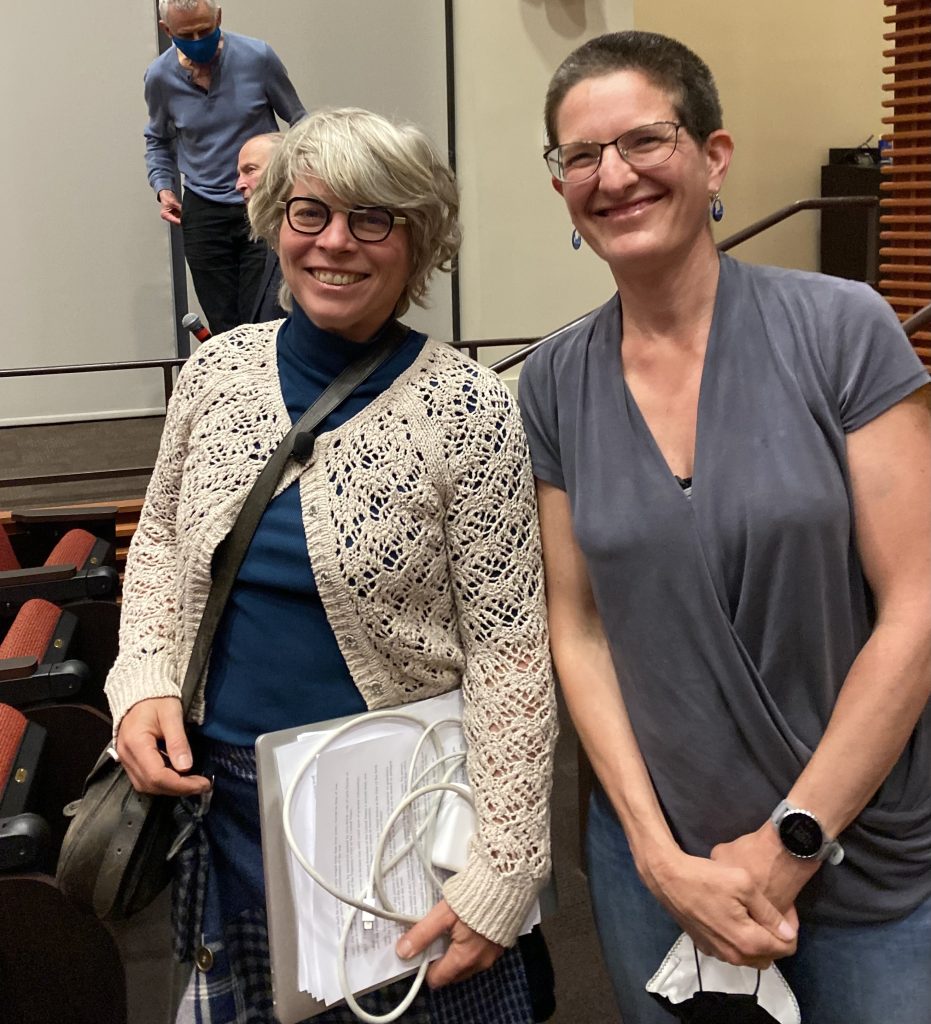
    I got to hear her speak at Stanford last year at a lecture sponsored by the McCoy Family Center for Ethics in Society, and like a true fan girl, I declared: I’m going to sit int he front and ask a good question. And then, I’m going to ask her for a selfie. And that’s what I did.

    So back to the piece she wrote about how to write. Here’s what I love about it: it’s surprising. It’s fun to read. I could actually go through it and explain how the piece itself conforms to the advice it is giving, like Mark Twain’s famous piece about spelling. (Maybe it wasn’t Mark Twain?

    Except where that devolves into being barely comprehensible, Jill Lepore’s piece brings you to brilliant resolution. 

    But my favorite part of the whole piece is where she writes this:

    You might begin, “John Singleton Copley was born in 1737 in a shack perched atop Boston’s longest wharf.” Or, you might want to begin with a claim: “Copley, long understood as a Tory, was loyal to nothing so much as his art.”

    The idea that a scholar might have choices in what they choose to share, how they choose to frame an argument, isn’t one that I learned anywhere in my academic career. I learned how to sharpen an argument, how to best present evidence, and that excellent thinking was crucial to good writing. I learned how to cite sources, include myself in a larger argument, and express with force and vigor my conclusions and disclaimers. But I never was taught that, if I did my job very well, it would be fun to read, that there was a story hiding in my argument that could satisfy.

    This looks like it was written by someone who loves what she does, who not only wants to write, but is bursting with desire to see what her students come up with.

    It’s too bad that I already have a PhD, or else I know where I’d be looking to go study! 

  • Academic High School Pressures

    A friend recently sent me this article from the Atlantic, written by Derek Thompson, wondering if I had some thoughts about it. If you haven’t seen the article, in brief, he wonders if the discussion about teen well-being has been missing considerations of academic pressures as drivers.

    I’m sorry, WHO exactly does he think has been missing this?

    I’ve been living in Palo Alto for the past nearly two decades, and in this area, where all students are above average, nobody has been missing this at all. For a few years, we had parent volunteers and professional guards stationed at our train crossings to make sure that more students didn’t throw themselves onto the tracks, primarily at finals time, when the academic stakes felt highest.

    There were practically fist-fights at a Board of Education meeting where there was a proposal to try to limit the number of Advanced Placement classes high school students could take, trying to calm the competition between students. With students trying to stand out for a college admissions officer, it was a race nobody could win, as students sought to keep up with their peers in ever-increasing academic loads. Unfortunately to my eyes, the proposal was ultimately voted down, with some parents outraged that their students might be disadvantaged against students in other districts with no such restrictions. 

    When I moved to Israel in 2017, I would try to explain to my new friends what we had been escaping, what it was like in Palo Alto. I talked to one of my first-graders’ parents, telling them that back in the United States, we lived in an academic pressure-cooker environment. “More than here?” She looked at me in surprise.

    I looked at her with even more surprise. As far as I could tell, my kids spent their days in Israeli schools with only the slightest of academic expectations weighing on their shoulders. Their teachers had opened every parent-teacher conference with questions about how they were enjoying themselves, who their friends were, suggesting possible playdates, and only afterwards giving the slightest sketch of their academic progress.

    A friend of mine in Israel had narrated with frustration that her high schooler was failing his math class. When the parents sat down with their student and the teacher to discuss his performance in class, the teacher had started out raving about their son. “He’s so wonderful,” she said. “Always helping other students in the class, and friendly, and so polite!” She went on and on about how much she adored him until the mother finally protested, “well, but he’s failing the class!”

    “Oh yes, that’s true, but I just have to tell you how much I adore your son.”

    The (formerly American) parents were frustrated. And this is what I got from a lot of other American parents too.

    I would explain: “We have a guard at our train tracks, because there is so much academic pressure on kids that they were literally throwing themselves on the track.” (This does not entirely accurately represent what I think the issue was, but it was a good shortcut to draw the contrast for an audience for whom this was shocking).

    “To be honest,” one American parent said to me, “we could use a little bit more of that academic pressure around here.” She laughed. I didn’t. Hadn’t I mentioned that we were talking about suicide  in the face of academic pressure? I had literally fled thousands of miles to escape what she was wishing for her children?

    While she lamented that the schools didn’t supply enough pressure to motivate her children, I didn’t tell her what an enviable position she was in. Without so much pressure on her children, she could continue to urge them towards her values of academic success. Her children could take lightly their assignments and she could tell them, “put some more effort in!”

    I felt I could never do that. At every juncture, I felt I had to affirm: mental health above academic pressure. As a parent, I was in the position of constantly having to assure my children that it didn’t matter so much. Lest they get the message that their scores had anything at all to do with their success in life, I had to constantly be telling them, “it’s okay, it won’t matter what grade you get on an assignment in fourth grade.” Which is to say, the ambient level of upset and stress was already so high that my role as a parent had to be to minimize the importance of every assignment.

    I wanted to be the parent who encouraged my student to put in a little more work, because they cared about what they were studying, because it was fun to learn and research a little deeper. Instead, fearful of what my town would eventually bring to my kids, I learned to say: “And what do you think will happen if you don’t do well?” In order to preserve their mental wellness, I had challenge their inconsolable conviction that the world would end with poor performance on a test or assignment.

    The summer before high school, my incoming 9th grader was so completely paralyzed by the thought that he was going to fail miserably, and that this failure would spell the end of his prospects for a successful future. 

    “Good. Fail,” I said. “That would be great.” 

    “WHAT?” He said. “Then I’ll never get into a good college,” he informed me certainly and with great indignance for my stupidity.

    “Who told you that?” I ask. “That’s ridiculous. You’re going to fail some time in life, you may as well learn what it’s like now.”

    He looked at me dumbfounded.

    “In fact,” I say. “I’ll pay you $100 if you fail a class. You’ll get the money, no strings attached.”

    I mean this. I mean it desperately. I can see that the dread of failure is much, much worse than any failure would be. I want him to learn 9th grade English, sure. But I more want him to learn: when the world ceases to compliment him, he can still survive. He can look like a failure in someone else’s eyes but still be a good person.

    So I have been the parent I never wanted to be.

    My parents never bribed me to achieve high grades, and I was always somewhat suspicious of parents who did. It seemed to me like a kind of extrinsic motivation that was superficial and likely to backfire. Now as a parent, I recognize that it was an act of desperation, an attempt to communicate via currency a set of values, to motivate a set of behaviors that regular communication might not be able to get across.

    And I have done the same thing. All my assurances that “it won’t matter” ring hollow so I have put my money where my mouth is: financial reward for bad grades. So he can know that I’m serious when I say it. So we can explore together what it feels like to not be a success in someone else’s eyes and to define our own successes. So he will know that the world won’t end with a bad grade, or a bad year. And, most of all, so that he will have the chance to practice the fortitude to stay off the train tracks.